

Umbraco Winter Keynote 2026
An eager community of Umbracians from all around the world gathered in front of our screens on Tuesday February 3rd, to get the latest updates straight from Umbraco HQ on what is coming next for our favourite open source CMS. We were not to be disappointed, with a completely brand new product announcement as well as exciting developments in the AI space, along with the usual business announcements and updates and a look at what’s been going on in the Umbraco community.
In this post, I’ll briefly recap some of the key announcements and what stood out to me, from my perspective as a technical lead in a digital agency building Umbraco and supporting Umbraco solutions.
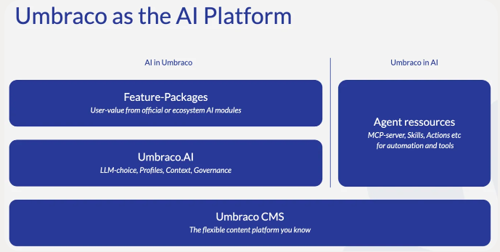
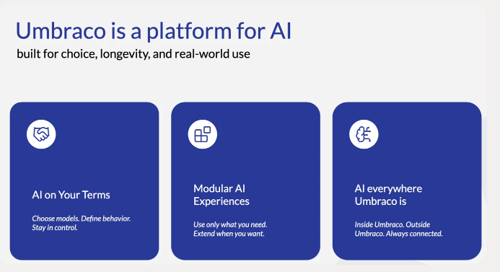
It wasn’t a huge surprise that a large part of the presentation focused on Umbraco’s new AI strategy. The announcements covered two aspects, integration of AI into Umbraco CMS, and investments in tools and skills to allow AI agents to work with Umbraco. Throughout the emphasis was on flexibility and modularity, and keeping the end-user in control. For agencies like ClerksWell this positions Umbraco really well for our clients who may have very specific requirements and policies around AI use and data protection. I enjoyed CTO Filip’s demo of how AI can be used within the back office to speed up content creation for editors, something that we’ve been experimenting with here at ClerksWell. Having officially supported tools frees up agencies to concentrate on helping our clients to craft personas and prompts to suit their business requirements rather than dealing with technical details of integration, so this is a really great move forward.
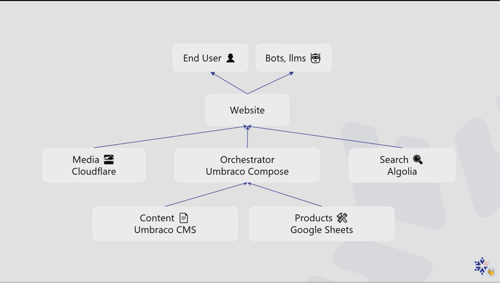
The new product launch turned out to be an enterprise offering called Umbraco Compose, an orchestration platform designed to bring together all sorts of disparate data sources and serve them via GraphQL to create extremely flexible and scalable, high performance websites. Umbraco Compose can surface data from Umbraco CMS as well as other sources such as CRM and ERP systems, product information and digital asset management systems, and use other integrations such as with search platforms like Algolia. Filip showed another impressive demo of a full scale shopfront combining product data with Umbraco CMS content and leveraging Algolia search. Anyone who’s done any sort of complex integration work knows how painful it can be, so Umbraco Compose promises a real breakthrough for agencies who need to b build complex integrations and highly scalable content delivery.
The business updates were generally aligned around positioning Umbraco as a dependable partner for enterprise, with announcements on 24-hour global support, ISO 27001 certification, 100% SLA on cloud services and a new Umbraco for Enterprise offering. We at ClerksWell have recently delivered our first Umbraco Enterprise implementation, so it’s good tosee the offering being strengthened to broaden its appeal. At the same time, the keynote also stressed that the emphasis on community for which Umbraco is known will continue, and highlighted some of the community innovations which have now made their way into the platform, such as the MCP server which amazed us all at Codegarden last year.
So to sum up, I really enjoyed the presentation and the demos, and I’m excited to see what this year brings. Here at ClerksWell we’re busy ramping up to full speed on Umbraco 17 migrations and can’t wait to start taking advantage of all the new features to build even better solutions for our clients
